Wednesday, January 5, 2011

The Departed

Excuse me, I think that's KTM calling about their new ad campaign.


A supermodel with purpose. I decide to take a walk,


down to Lajitas cemetery.


Lajitas was an old border crossing, used by indians, bandits, and prospectors.


Many of the grave markers are unreadable today.


It was in the town of Griffin, in the year of '65...


To those of y'all that don't know, you better ask somebody.

Tuesday, January 4, 2011

The Hills of Mexico

The next morning, I have a missed call from Mary. When I phone her back, I receive some very unexpected news.
Trans-Pecos bank has submitted a counter, and it's very close to my original price. My heart begins to throb. I had
never really thought it would get this far. I counter-offer. This will give me a few minutes to think things over. First,
I call Malcolm, who manages my investments. After a long discussion, he reaffirms what I already know...the place
is a steal. The minute I hang up, Mary calls. The bank has accepted my offer. Holy shit! I head south, hoping to make
sense of what I've just done.


Farm Road 170, otherwise known as the River Road, heads east from Presidio,


following the banks of the Rio Grande River.


The road is nothing if not dramatic,


affording expansive views of some breathtaking scenery.


Rising up from the valley floor,


the River Road gains elevation quickly.


This picture illustrates the severe grades awaiting the lucky motorist. Crossing this pass...


reveals the spectacular mountains of Big Bend.


After several miles, I came across this old film set.


Both the exteriors,


and the interiors were constructed in the traditional manner, which works to the structures' aesthetic advantage.


Down by the riverside, dried mud.


Monday, January 3, 2011

No Country For Old Men

I awoke with this crazy idea. And it stayed. And it stayed. The night before at the Jett, I made friends with an art
professor from New York, and he and his girlfriend invited me to his place for a steak and some red wine. Having
expressed a curiosity in property costs, I was given the number of a real estate agent. What could it hurt to take
a look? The agent's name was Mary, and the first thing she showed me was 12 acres of land at antelope hills.


It was a pretty piece of property a few miles outside town with views of the Davis mountains, but it was too much
work. I needed a place to work right now.


Next, I was shown a partially renovated barn. It was a nice listing as well, but to be fair, I was more interested in
this old truck than the property itself. Then, I was brought here.


The building was once a gas station, and it had been partially renovated by a sculptor.


Unfortunately for her, the house was repossessed and was now owned by the bank. It would take some work, but
the place had a lot of potential. A closer look revealed new insulation, new electrical, and new roofing work had been
completed on both the main house and the casita. I asked Mary how much the property was listed for. Is that the
price for the main house, or the casita? Both, she answered. I became genuinely interested.


I asked about the viability of a mortgage, and Mary took me to see her friend Chip down at Marfa National Bank.
You may recognize him as Javier Bardem's second victim in the movie "No Country For Old Men". Based on my
discussion with Chip, it appeared there might be a few obstacles in my getting a mortgage. I thanked him for his
time and for the benefit of his experience, and began to think of another strategy.


I went down to the Food Shark for some inspiration, and found it,


embodied in the form of a red 1966 International Harvester.


What was I thinking? It takes time to buy real estate. I'd been living in New York for more than twenty years, now
I was moving to Marfa, Tx? I'd only been in town for four days. It's sheer madness.


A dozen good reasons howled collectively in my head, no, no, no! After a delicious pulled pork sandwich, I thought
I'd found a solution. I picked up the phone and called Mary. When she answered, I instructed her to make a cash
offer so ludicrously low, the bank was sure to reject it.

Sunday, January 2, 2011

Marfa, Tx

On New Year's Day, everything in town is closed. I spend the day lazily at the hotel, a welcome break from many
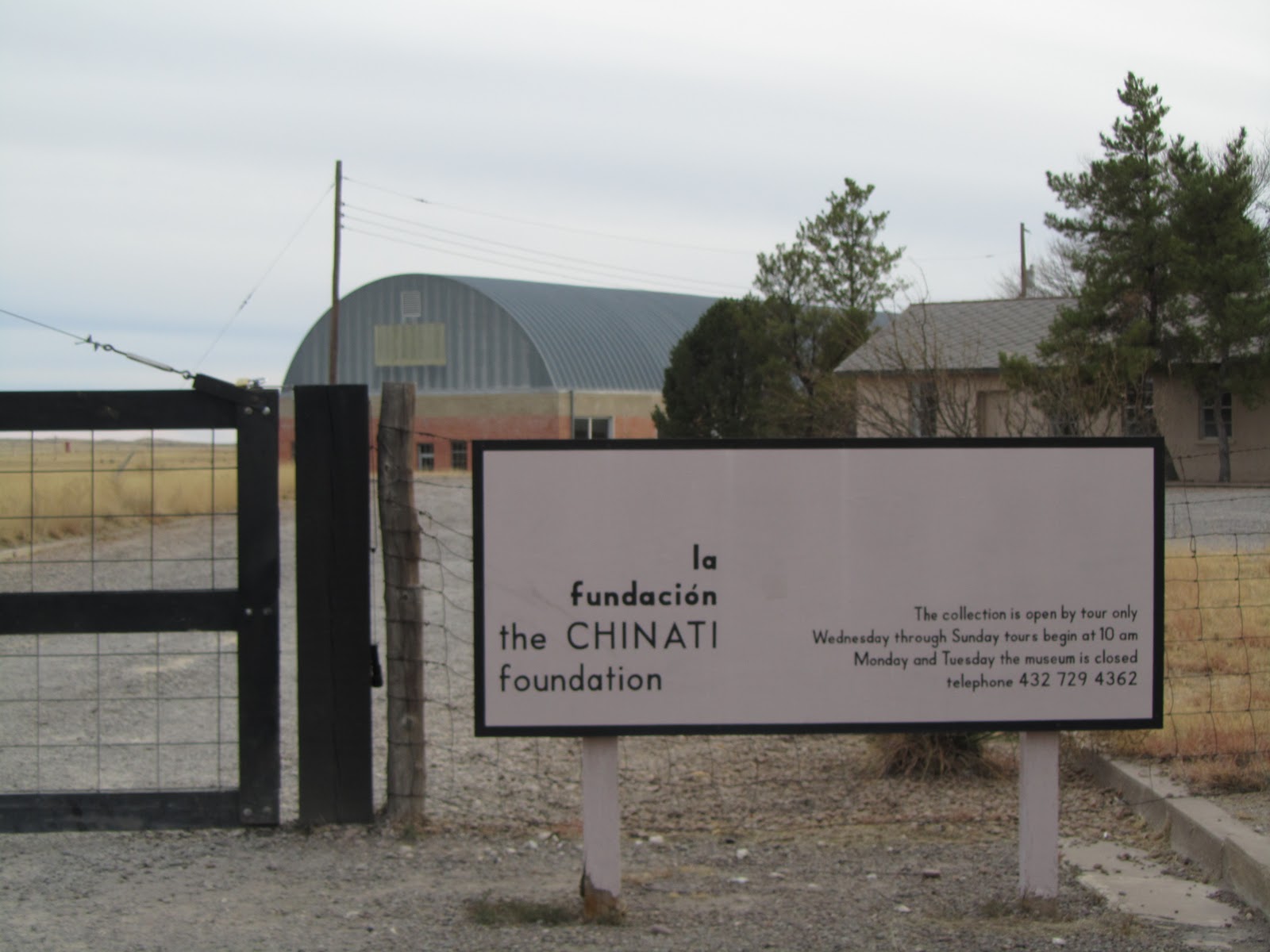
weeks on the road. One of the most important forces in Marfa is the legacy of the late Donald Judd and the Chinati
Foundation. The following day, I resolve to take in some of the local culture.


The Chinati Foundation is the deeply-pocketed endowment which continues the Judd tradition of providing permanent
exhibition space to artists. The foundation administers tours of work by Donald Judd, Dan Flavin, John Chamberlain,
Richard Long, Claes Oldenburg, Roni Horn, and other art world heavies.


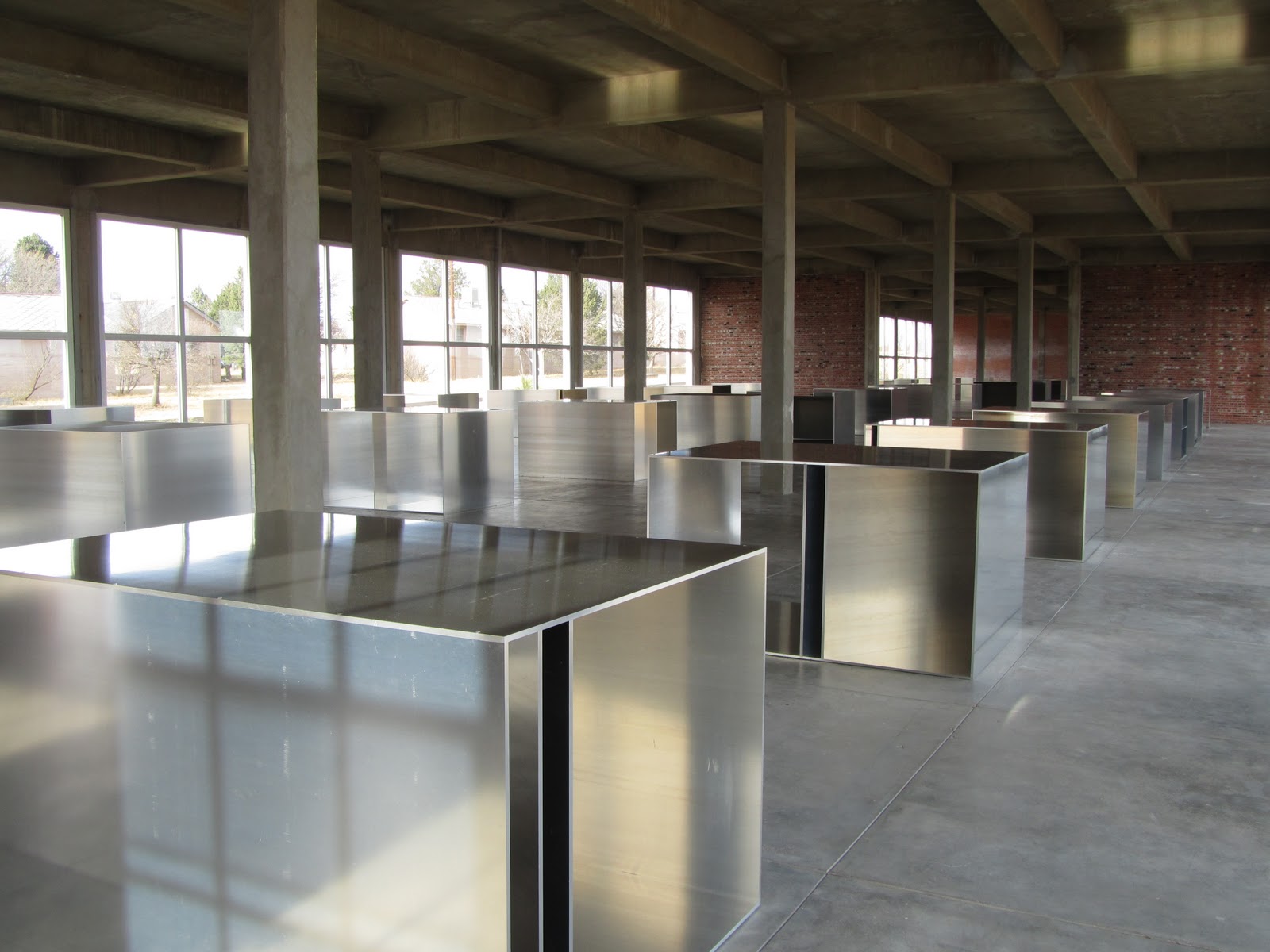
This building was once an internment camp for German prisoners of war. Now, it houses an exquisite collection of
aluminum boxes by Donald Judd.


You've been warned!


The exhibition begins humbly, in a small room with four, exquisite works in metal.


But once one leaves this room, and emerges in a vast space filled with luminous sculpture, all pretense of humility
vanishes.


For someone who had only seen Judd's work in a museum, and not been particularly fond of it, the art is a revelation.
My views on the artist are turned on their head. The sculptures are of the highest order.


Some prisoner instruction has been allowed to remain, an unintended irony in this well
regulated museum. A serious problem with viewing art today, particularly sculpture, is
the mania for preservation enforced on patrons by most modern galleries. Chinati is no
different. In fact, my guide stated that according to Judd's wishes, it was one of the foun-
dation's aims to preserve the work "permanently". A nice idea, I guess, but an impossible
one nevertheless. For the sake of the illusion of permanency, visitors are hustled through
the room under the watchful eye of some young hipster who, in my case, made no secret
of her disdain for the whole affair. It is a bit of a crime not to be allowed to spend more time
with the work, or to view it alone. After a scant 20 minutes, I am ushered outside, where
I'm given another 20 minutes to tour the rest of the grounds.


Across a vast field of grass, one encounters another major installation by Judd,


which consists of poured concrete forms arranged in a grassy field.


The severity of the geometry of the sculpture is softened by the protean elements of the sky and the surrounding
grasslands....


...while each step forward reveals unexpected visual pleasures.


I think that allowing someone to look at but not touch sculpture is akin to holding a plate of food beneath the nose
of a starving person. I run my hands across the rough concrete.


Again, the unpredictable surfaces of the sculptures soften their conceptual rigidity,


...as do biological processes, such as the residue of dripping water on the back surface of this construction. About
two-thirds of the way along my tour of the piece, a foundation employee informs me that the facility is closing. One
hour before sunset? What a spectacle these things must be under a setting sun.


I hop in Brünhilde and head into town to peer through the window of another Chinati building not featured on my "tour".


Inside are several nice Chamberlain sculptures.


Just past the gallery, I stumble upon the Marfa Theater.


The space tastefully retains much of its distressed character.


Beyond the theater is Godbold, Inc.,


a mill serving the large ranching presence in the Marfa area.


Another vehicle of noteworthy dereliction.


It's a beautiful paint job.


Other examples of metal in distress can be found on the water tanks of Godbold, Inc.


It's been a long afternoon, so I take a break at Padre's.


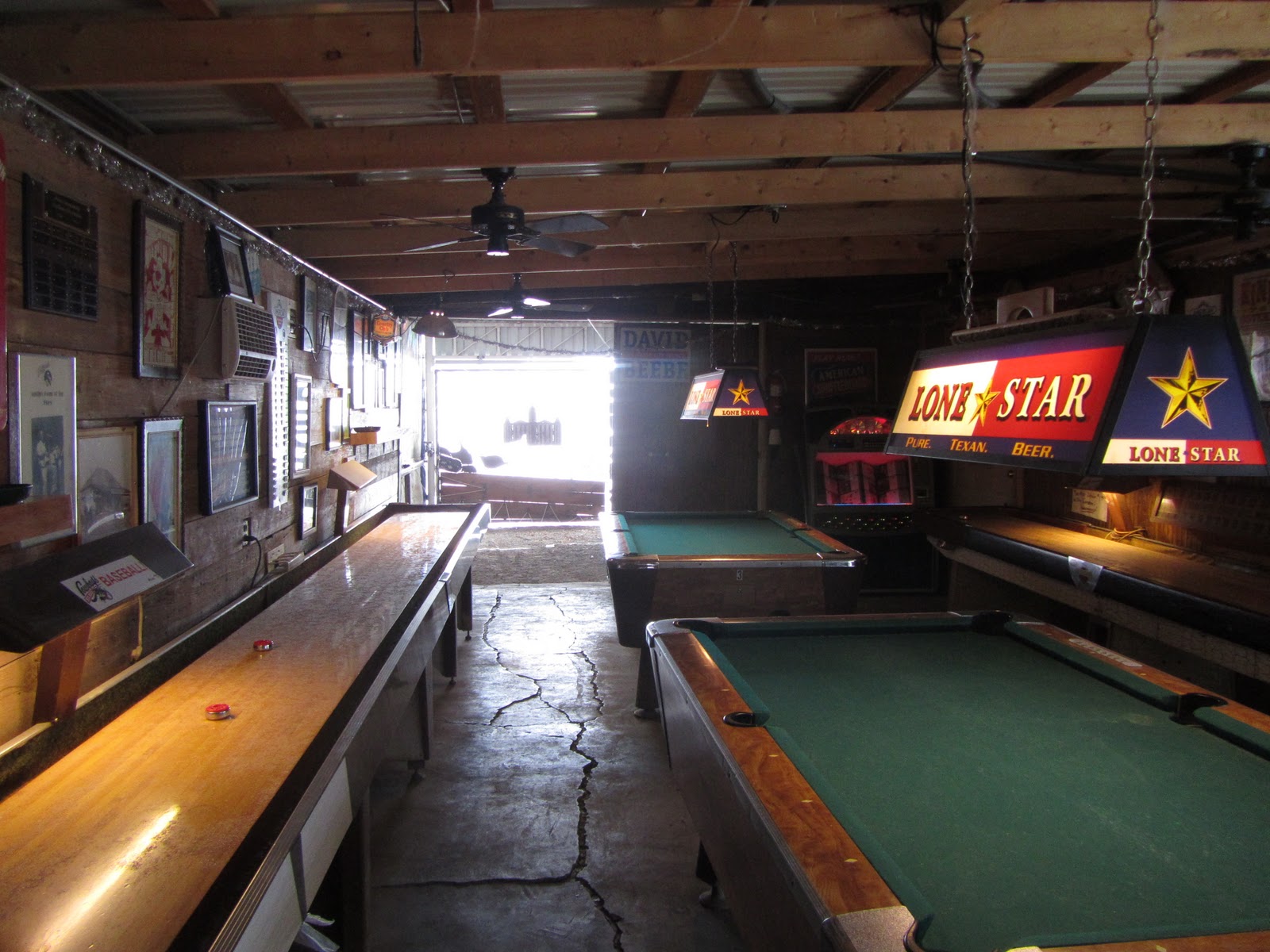
Inside, it's classic Texas.


Lone Star and pool. Or in my case, Shiner.


I watch the sinking sun, thinking about the brilliant artwork I've just seen, eating a burger.


After lunch and a few drinks, I continue my tour.


Beside this innocuous building,


I discover another ghost of Judd. A true pioneer, Judd came to Marfa in the 70's and began buying up real estate,
some of which he used as studio space.


One of several of Donald Judd's studios in Marfa, Tx. After the walk, I take the bike east, along Highway 90. A mile
out of town, I encounter a small herd of Pronghorn.


Noticing me, they head off into the distant plain.


30 miles to the west, near Valentine, Tx, is Prada, Marfa.


Prada Marfa is a site-specific installation, underwritten by Ballroom Marfa. When it was first constructed, the work 
was graffitied, shot, and some of its shoes were stolen. These days, the bottoms of the shoes and handbags have 
been removed, and motion detectors installed. The bullet holes remain.


The price of business in West Texas: dust and tumbleweeds.


The ride back to Marfa takes about 20 minutes. As I pull in to the hotel, I realize that 
I really like it here.